Commander: ship AI-written code fast, without losing control of it
AI coding assistants let teams ship more code than they can review. Commander is a DevOps suite from Clustr Labs that keeps that code governed from pull request to production: automated deploys, test and standards audits on every change, AI-assisted debugging, and one dashboard leadership can read.
Updated October 2026
What is Commander?
Commander is Clustr Labs' DevOps suite for teams writing software with AI coding assistants. Its modules automate build and deployment from Git, run test, coverage and standards audits on every change, give AI assistants controlled access for debugging, and turn the results into dashboards, so AI-assisted code stays secure, tested and conformant.
| Built for | CTOs, VPs of Engineering, platform and DevOps teams |
|---|---|
| Problem | AI coding tools adopted faster than the organization can govern their output |
| Modules | Deploy, Scrutiny, Console and Picasso, with Sentinel in design |
| Source control | Receives changes from Git repositories such as GitHub |
| Sign-in | OIDC single sign-on with your existing identity provider |
| Testing | Runs Vitest suites and captures coverage and telemetry for every run |
What does Commander do across the delivery pipeline?
Commander covers the delivery pipeline from pull request to production: Deploy builds and releases from Git, Scrutiny audits every change, Console controls AI-assisted debugging, Picasso turns results into dashboards, and Sentinel, in design, watches production.
Deploy: build and release from Git
Commander receives changes from your repositories and runs the build, deployment and database migration scripts on your servers. Administrators sign in with your existing SSO and watch deployment activity from one interface.
Scrutiny: audit every change
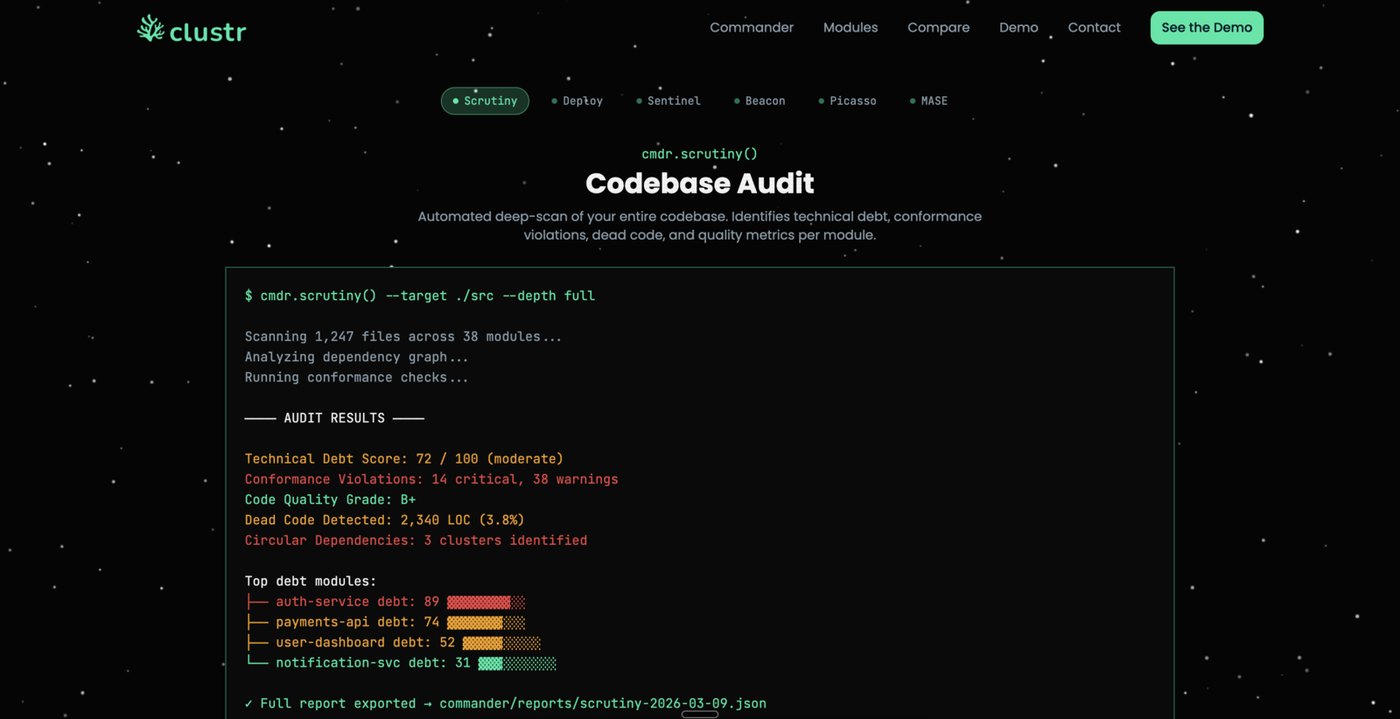
On each pull request, Scrutiny discovers the test suites, runs them, and records coverage and performance telemetry. It runs standards and technical-debt audits and stores dated results, so reviewers see what changed before they approve.
Console: debug with AI, under control
When a bug appears, a developer can capture console output and grant an AI assistant time-limited, whitelisted access to inspect errors, the page structure and performance. The session ends when the developer ends it.
Picasso: dashboards leadership can read
Test telemetry, coverage and audit results are turned into dashboards, such as latency percentiles over time and a coverage gauge, so engineering leaders can see quality trends, not just pass or fail.
Sentinel: watch production
In design: health checks and synthetic user journeys for apps and APIs, with immediate outage alerts that link the failure to the deploy that preceded it.
What does an engineering organization get?
An engineering organization gets controls for AI-written code at every stage: an automated deploy pipeline, audit reports on every change, quality dashboards, and, marked as roadmap items, a governed deploy gate and production monitoring.
Automated deploy pipeline
Build, deploy and migration from Git, behind your SSO, with deployment activity visible to administrators.
Scrutiny audit reports
Test, coverage, telemetry and standards results for each change, stored with dates so trends and regressions are visible.
Governed deploy gate
CI gates that fail a change when type safety, coverage or standards regress, with clear remediation, so non-conformant AI code does not ship.
Engineering quality dashboard
One view of quality, coverage and performance across the codebase over time.
Production health monitoring
Health checks, synthetic journeys and outage alerts, correlated with recent deployments.
Commander, answered directly
Updated October 2026
How do you govern code written by AI coding assistants?
The same way as any code, but automatically and on every change: run the tests, measure coverage, audit against your standards, and block deployment when quality regresses. Commander's Scrutiny and Deploy modules do this in the pipeline, so review keeps pace with how fast AI produces code.
Does Commander replace our CI/CD tools?
It works alongside your source control and identity provider: it receives changes from Git, signs people in through your existing SSO, and runs your build and deployment scripts. Talk to us about how it fits the pipeline you already run.
Can AI assistants debug our application safely?
Commander's Console gives an AI assistant time-limited access to a whitelisted set of commands, granted and ended by the developer, rather than open access to the system.
What is the difference between Commander and Scrutiny?
Commander is the suite; Scrutiny is its audit module, which runs tests, coverage, telemetry and standards checks on each change. Deploy, Console, Picasso and Sentinel are the other modules.
How does Commander relate to Clustr's AI coding training?
Clustr trains engineering teams on AI coding assistants such as Claude Code, Cursor and GitHub Copilot. Commander is the governance that lets those teams keep shipping faster without lowering the bar on quality and security.
We use cookies
We use cookies and Google Analytics to understand how visitors use our site. Privacy Policy