


The Short Answer
How does Clustr run an AI enablement engagement?
Clustr runs AI enablement in four phases: Assess, Educate, Enable, and Scale. We baseline every team with SINA, train each group live on real tasks in the tools it already has, help each person build one workflow that runs in their week, then expand what worked and re-measure. Typical engagements run 8 to 12 weeks and start with a single team.
We start with people because that is where most AI spending stalls. The gap is rarely the technology. Teams were never taught to use it, so even good platforms sit unused.
The Engagement Model
Four phases. Each one builds on the last. No phase is skipped.
AssessEducateEnableScale
Assess
Every engagement starts with SINA, our AI literacy and assessment platform. SINA maps your current state: team capabilities, workflows, and existing tools, giving us a clear picture of where friction lives before we recommend anything.
- SINA-powered assessment
- AI readiness score
- Team skill gaps identified
- Priority use cases ranked
Educate
Live activation waves: hands-on sessions of about four hours where each group works on real tasks in the tools it already has, shaped by the SINA baseline. We don't lecture. Nobody leaves without a working setup tied to a task they do every week.
- Activation waves by team or region
- Weekly small-group sessions
- Manager enablement track
Enable
We implement the right tools against redesigned workflows. Internal champions are activated, and we drive adoption, not just deployment.
- Workflow automation live
- Productivity benchmarks set
- Champions onboarded
- Capstone: one real workflow per person, built and presented
Scale
Once adoption is proven in one team, we expand the model org-wide. Playbooks are documented, systems are integrated, and the gains compound. SINA stays behind as your ongoing AI literacy and enablement platform long after the engagement ends.
- Org-wide rollout plan
- Documented playbooks
- Executive dashboard
- SINA platform access retained
Accelerators
The platforms behind each phase
SINA, Acro, Marina, and Commander are the platforms Clustr runs engagements on, configured to your teams. None are sold as standalone software, and SINA stays with you after the engagement ends.
- SINAAI Literacy Measurement & TrainingAssess and re-measure: the baseline before training and the score after it.
- AcroValue Engineering & Agent SimulationBefore a workflow is built: the business case and a safe simulation on mock data.
- MarinaAI Operating System DashboardRunning the program: inventory, intake, roadmap, adoption and spend in one place.
- CommanderDevOps for AI-Built SoftwareFor engineering teams: build, deploy and audit of AI-written code.
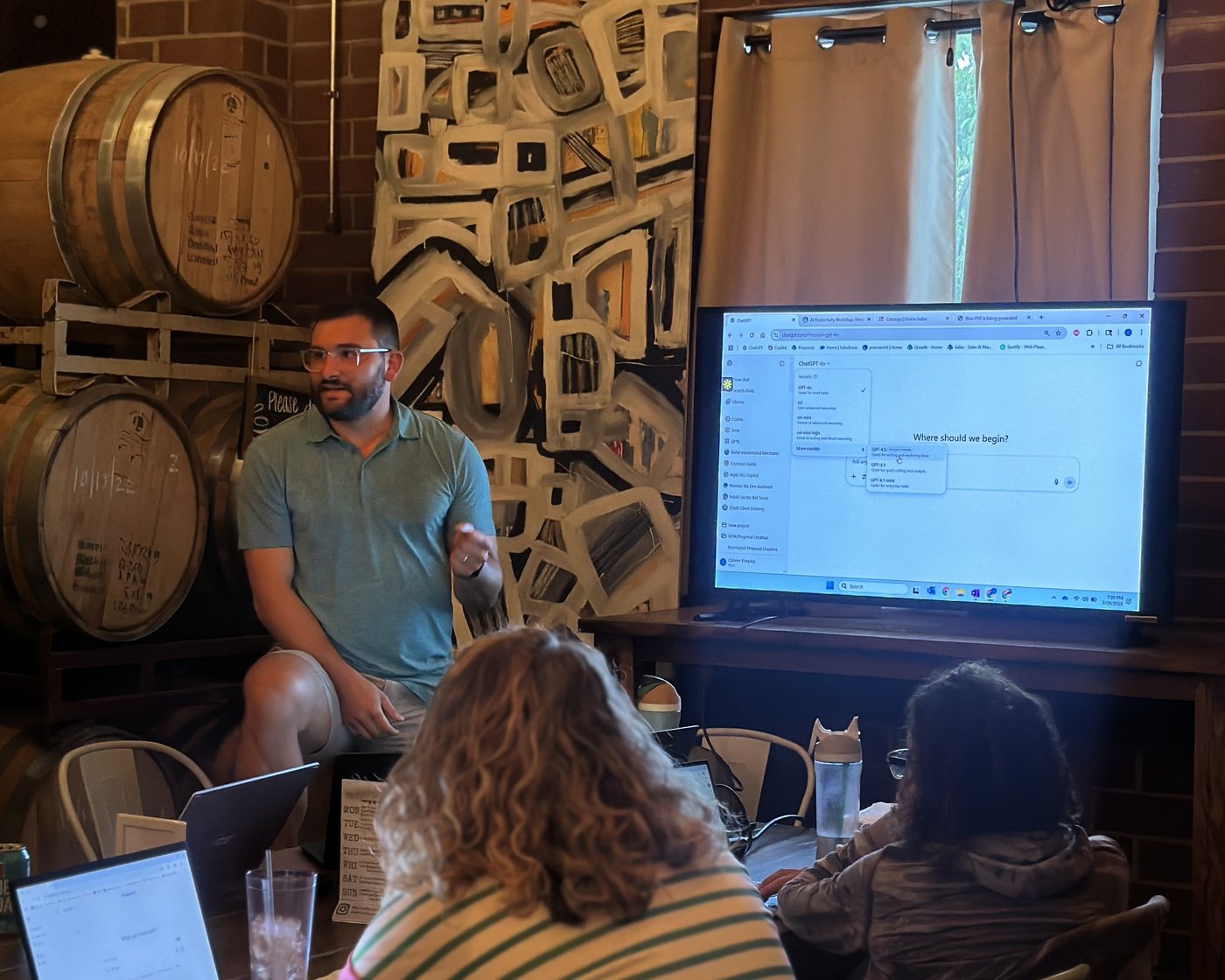
Framework working session
How every program ends
The Capstone: build one thing that runs in your week
Every program closes with a capstone. Each participant picks the workflow that costs them the most time, builds it with AI on their own real work, and presents it to the group. Not a demo, and not a slide about an idea.
Done means
It runs
On the participant's own work, on a real account or case. Not a made-up example.
It produced
One real output they can put on screen and defend.
It is recorded
One successful run captured, so a bad demo day cannot take it away.
They can explain it
All eight blueprint sections, out loud, without notes.
The one-page blueprint, eight sections
- 1
The job. The recurring moment it runs in, who it serves, and minutes back per week.
- 2
The trigger. Manual, scheduled, event or threshold, and why that one.
- 3
Task or loop. Runs once and hands back an output, or stands watch and repeats.
- 4
The model. Which model was picked, and why.
- 5
The instructions. The exact instructions, verbatim. This is what the room reads.
- 6
The context. What knowledge was loaded and which tools it can reach.
- 7
The run. Real input in, real output out.
- 8
The honest part. Where it gets things wrong, and the judgment the person still adds.
Pick and build
Choose the workflow, draft the blueprint, and get a working first version before the session ends.
Sharpen and rehearse
Improve it with real material, then present it out loud to the group.
Present and re-measure
Five minutes each, a SINA re-assessment, certificates, and every blueprint added to a shared library.
FAQ
Common questions
Updated November 2026
What is the 5.0 Framework?
The 5.0 Framework is Clustr's methodology that prioritizes People over Process over Technology. Rather than deploying AI tools and hoping adoption follows, we start by building AI literacy in your team, redesigning workflows to remove friction, and only then implementing technology, ensuring every tool is used and every investment pays off.
Why start with sales and growth teams?
Sales and growth teams produce fast, measurable wins: shorter response times, more pipeline, better close rates. These early results create internal champions who advocate for broader AI adoption, build executive confidence, and fund the expansion into operations, HR, and beyond.
What does the engagement process look like?
Our engagements follow four phases: Assess (map current state and identify priorities), Educate (role-specific AI literacy training), Enable (implement tools with real adoption support), and Scale (expand proven models across the organization). Each phase builds on the last.
What is SINA?
SINA is Clustr's AI literacy and assessment platform. Every engagement starts with SINA to assess your team's AI readiness, and it stays behind after we leave as your ongoing enablement platform. It delivers role-specific learning paths, hands-on exercises, and progress tracking. It's part of our broader accelerator ecosystem alongside Acro, Marina, and Commander.
How long does a Clustr engagement take?
Typical engagements run 8 to 12 weeks and start with a single team, so you see measured results before you scale. The four phases run in order: Assess, Educate, Enable, then Scale.
What are Clustr's accelerators?
The accelerators are the four platforms Clustr runs engagements on. SINA measures AI literacy before and after training. Acro proves a use case before it is built. Marina runs the AI program from one dashboard. Commander governs AI-built code. None are sold as standalone software, and SINA stays with the client after the engagement ends.
Do Clustr programs end with a capstone?
Yes. Every program ends with a capstone: each participant builds one AI workflow that runs on their own real work, documents it on a one-page, eight-section blueprint, and presents it at a showcase alongside a SINA re-assessment. A capstone only counts when it runs, has produced a real output, has a recorded run, and the participant can explain every section of the blueprint.
How is Clustr's capstone different from other AI training capstones?
Other providers run capstones too. Ours differs in four ways: it must run on the participant's live work rather than a sample case, the room reviews the instructions behind each build rather than just the output, it is paired with a measured SINA re-assessment, and every blueprint goes into a shared library the client keeps.
Ready to start with your people?
Book a 30-minute call. We'll assess where you are and outline a path forward. Typical engagements run 8–12 weeks and start with a single team, so you see measured results before you scale.
We use cookies
We use cookies, Google Analytics, and business visitor identification (Apollo) to understand how visitors and companies use our site. Privacy Policy