The AI enablement program built on people
Clustr runs human-first AI enablement programs for enterprise teams: we prepare your people, workflows, and governance so the AI your company already pays for becomes daily work. Literacy is baselined and measured with SINA, our AI literacy platform, and adoption is the deliverable.
What is AI enablement?
AI enablement is the work of preparing an organization's people, processes, and governance to actually use AI, not just deploy it. It sits after the technology decision and before the productivity gain: tools are licensed, but workflows have not changed, and enablement is the bridge.
It differs from AI training and AI adoption in scope. Training builds individual skill. Adoption is the outcome you measure. Enablement is the full program that connects them: literacy baselines, role-based training, workflow redesign, champions, governance, and measurement, run as one motion. Companies increasingly staff this as a function, hiring AI enablement managers and specialists; Clustr is the partner that builds the program with them, or stands in until that hire exists.
Where enablement is missing, AI investment stalls
Technology-first rollouts
Most AI initiatives start with the tool and hope behavior follows. It rarely does. Enablement starts with people: who needs what capability, in which workflow, measured how.
Training without a program
One-off workshops create a spike of enthusiasm and no lasting change. Enablement wraps training in baselines, champions, governance, and re-measurement so the change compounds.
Governance as an afterthought
Shadow AI grows wherever the governed path is unclear. Enablement designs safe use and real use as the same thing: approved workspaces, clear data policy, and training on what belongs where.
No owner on the org chart
AI enablement is becoming a named function, but most firms have not hired for it yet. We run the program with your team and leave behind champions, playbooks, and SINA so the capability stays.
What the enablement program includes
One motion from baseline to measured adoption, delivered in-person first and hybrid by design. Every engagement starts with a SINA literacy baseline and ends with re-measurement, so progress is evidence rather than anecdote.
Literacy baseline
SINA assesses every participant so the program starts from evidence: fluency by role, gaps by team, and the friction points where work slows down.
Role-based training
Live sessions on ChatGPT, Copilot, Claude, or Gemini, built on your team's real documents and processes. Each role learns the workflows that matter in their daily tools.
Workflow enablement
The highest-impact workflows get rebuilt with AI inside your governed environment: custom GPTs, agents, and automations built with your people so the skill stays in-house.
Champions and governance
A champions group carries adoption peer to peer, while governance, data policy, and approved tooling make the safe path the easy path.
Measurement and handoff
SINA re-measures literacy and usage as the program runs. Leadership gets adoption data, and SINA stays behind as your ongoing enablement platform.
How AI enablement differs from training and adoption
The three words get used interchangeably. They should not be. Training builds skills, adoption drives usage, and enablement is the system that produces both and makes them stick. Here is how we draw the lines.
| AI training | AI adoption | AI enablement | |
|---|---|---|---|
| What it is | Building individual skill on AI tools | The measurable outcome: AI used in daily work | The full program connecting skill to outcome |
| Unit of change | A person | A behavior | An organization |
| Typical form | Workshops, cohorts, courses | Usage metrics, fluency scores, workflow counts | Baseline, training, workflows, champions, governance, re-measure |
| Fails when | It is generic and unconnected to real work | It is declared from license counts | It is skipped entirely |
Adoption you can see on a chart
Every engagement is baselined with SINA, our AI literacy platform, and re-measured as the program runs. Leadership sees fluency by role, usage over time, and where to invest next.
AI adoption · pilot to daily use · 90-day program
Baselined with SINA, re-measured at week 12. Adoption is the deliverable.
Enablement across every major platform
Enablement is platform-agnostic by definition. We run the same human-first program on whichever stack your firm licenses.

Enablement programs, not seminar series
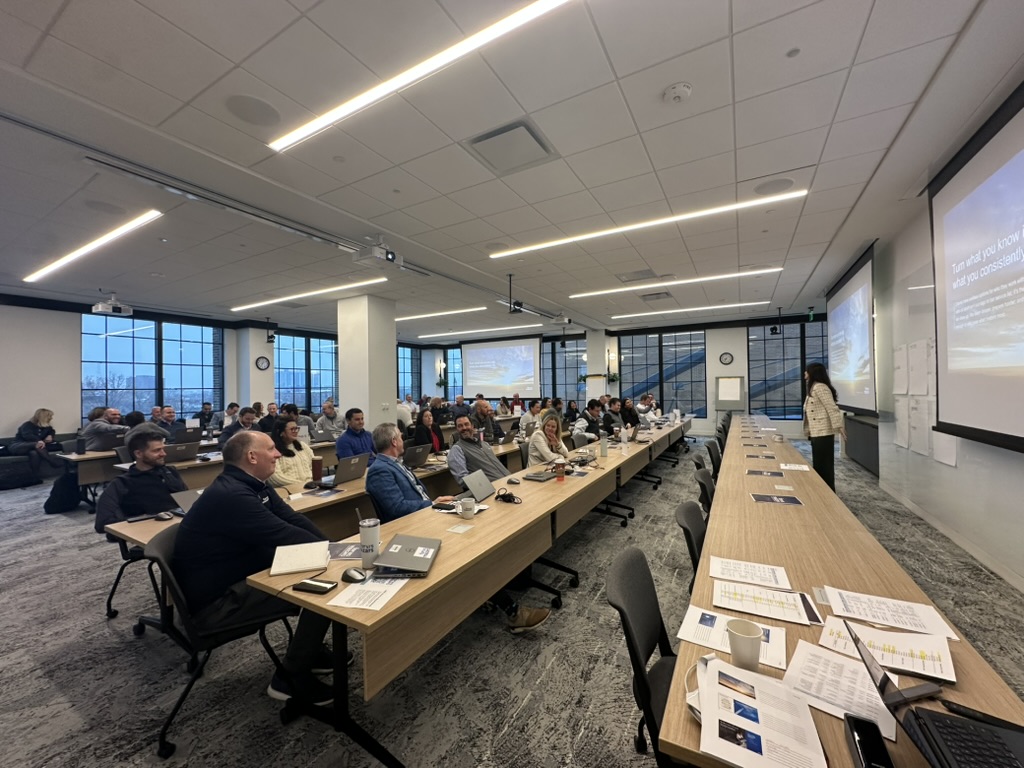
At Cresa, a leading North American commercial real estate firm, we ran an AI fluency and workflow enablement program: SINA baseline, role-specific training for growth and finance teams, and automated workflows built inside the tools they already license. At Forvis Mazars, CPE-accredited enablement workshops trained 300+ professionals and refreshed the firm's operating model for AI.
AI Enablement, answered directly
Updated August 2026
What is an AI enablement program?
A structured engagement that takes an organization from licensed AI tools to measured daily use. Clustr's program includes a SINA literacy baseline, role-based training, workflow builds inside your governed environment, a champions group, governance support, and re-measurement, typically over about 90 days.
What does human-first AI enablement mean?
It means the program starts with your people, not your technology. We assess what each role can do today, teach on their real work, and design workflows that augment your best performers rather than route around them. Tools change; the capability we build stays with your team.
How is AI enablement different from AI training?
Training builds individual skill and is one component. Enablement is the whole motion: baseline, training, workflow redesign, champions, governance, and measurement run as one program. Training answers 'can people use the tool.' Enablement answers 'did the organization change how it works.'
Do you work with in-house AI enablement managers?
Yes, and it is one of our favorite setups. Where a firm has hired an AI enablement lead, we bring the program, curriculum, SINA measurement, and delivery capacity, and they own the outcome internally. Where the hire does not exist yet, we stand in and build the playbooks that role will inherit.
How much does an AI enablement program cost?
Programs are scoped to team size, format, and depth, from a department pilot to firm-wide enablement, and priced against the AI investment you have already made. The fastest way to a number is a short briefing where we map your teams and recommend a scope.
Which platforms does the enablement program cover?
All the major ones: OpenAI ChatGPT, Microsoft Copilot, Anthropic Claude, and Google Gemini, plus the systems around them. We are tool-agnostic, train on the stack you already pay for, and advise honestly when something is missing.
We use cookies
We use cookies and Google Analytics to understand how visitors use our site. Privacy Policy