How Accounting Firms Use AI for Business Development (Not Just Tax Work)
How can accounting firms use AI for business development?
Accounting firms get the most from AI in business development when it is applied to three things partners and client-facing staff already do: planning accounts, preparing for client meetings, and following up. Tools such as Microsoft Copilot can draft account plans, summarize a client's recent history before a meeting, and turn notes into next steps. The hard part is getting people to use them, not the technology.
Most AI guidance written for accounting firms is about the technical side of the work: tax research, audit sampling, and document review. Professional bodies and software vendors cover that well. The client-facing side gets far less attention, even though it is where many firms feel the pressure to grow.
Why does AI adoption stall on the client-facing side of accounting firms?
We see the same four reasons again and again.
- Utilization pressure. Professionals measured on billable hours do not have time for AI training that does not connect to their clients. A generic webinar loses to a client deadline every time.
- Licenses without a use case. Microsoft Copilot often arrives firm-wide with an announcement and a link to Microsoft's own training. People try it once on a generic task, get a mediocre result, and stop. We wrote about this pattern in why Copilot licenses go unused.
- Offices that work differently. A regional office's clients, team structure, and habits differ from headquarters. One script for the whole firm lands in some offices and misses in others.
- Uncertainty about client data. When nobody has said clearly which tools are approved and what can go into them, careful professionals default to not using AI at all.
What does AI training for accounting firm business development look like?
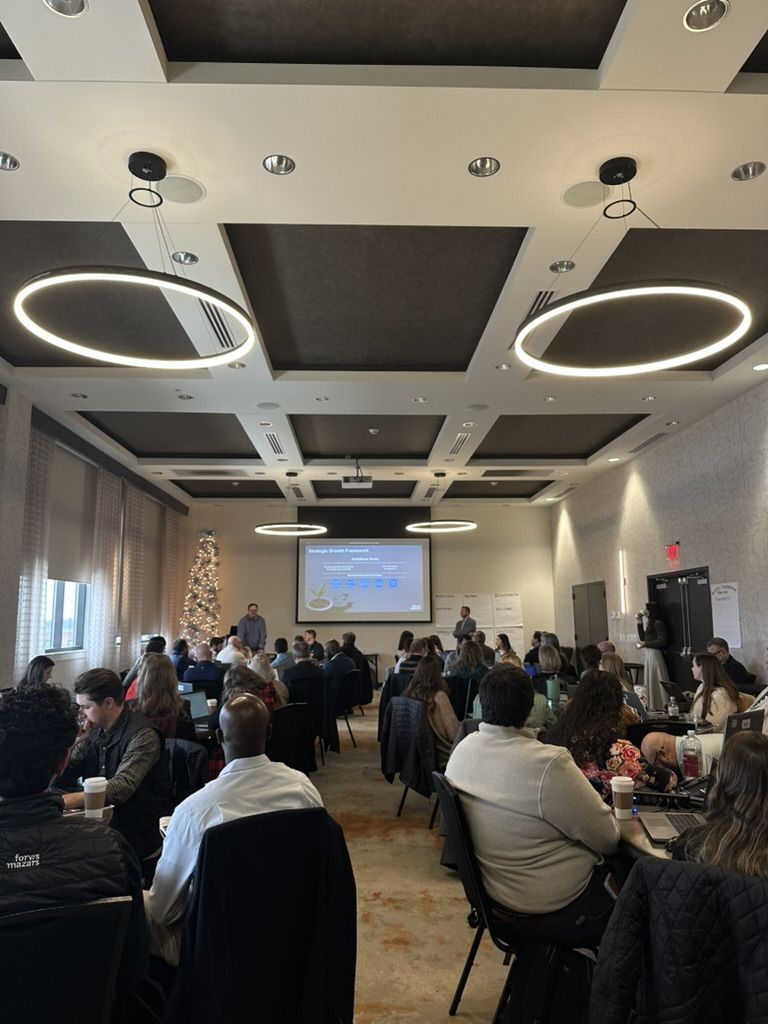
Our work with Forvis Mazars, a 40,000-person professional services and accounting firm, shows the shape that has worked for us. It was a series of regional, in-person, instructor-led workshops on modern business development, and it trained 300+ professionals.
- Discovery before every session. Before each regional workshop, we learned the local team structure, client profiles, and existing workflows. The session then taught against how that office actually works.
- Standardized account planning. A single account planning approach, taught in the room and backed by templates, gave every office the same structure. AI helps fill the plan in, but the structure is what makes the output consistent.
- Meeting preparation with AI. People practised using the firm's existing AI tools, including Microsoft Copilot, to prepare for real client meetings and presentations.
- CPE accreditation. The workshops were CPE-accredited, and each participant earned 4 CPE hours. For professionals with annual CPE requirements, that turns AI training from a cost on their time into something that also meets an obligation.
- Follow-through. After each session came customized account planning templates, a summary of key insights, the gaps we observed, and next-step guidance for continued adoption.
The results the firm saw: account planning standardized firm-wide, an operating model refreshed with guidance on when and how to use AI, and more consistent meeting engagement across regions. The series is Phase One of a multi-year, enterprise-wide enablement strategy.
Where should an accounting firm start with AI for business development?
Start small and concrete. Pick one region or practice group and one workflow people already find tedious, such as preparing for a client review meeting. Teach it in person, on the firm's own licensed tools, with real client situations in the room, and give people a template to keep using afterwards.
Three practical rules help:
- Use the tools you already pay for. If the firm runs Microsoft 365, Copilot is the natural starting point. Buying a new tool rarely fixes an adoption problem.
- Write the data rules down. Tell people which tools are approved and what client information belongs in them, then teach it in the session.
- Measure use, not attendance. Track whether account plans and meeting prep actually change, not how many people sat through a session. Our guide to measuring AI adoption covers how.
Should accounting firms train in person or online?
For client-facing skills, in person usually wins. People in the room ask the questions they would never type into a chat box, and they see a respected colleague get a real result on real work. Online, self-paced courses are useful for broad awareness. We compare the formats in instructor-led vs self-paced AI training.
If your firm is weighing a program like this, our page on AI and Copilot training for accounting firms sets out how we run it.