Generative AI for manufacturing on the plant's real documents
Manufacturers run on documents: SOPs, work instructions, quality records, maintenance logs, supplier contracts and ERP reports. Clustr trains plant, quality, supply chain and office teams to use generative AI on that work, in the AI tools your IT team already approves, and measures whether it changed how people work.
How can manufacturers use generative AI?
Manufacturers get the most from generative AI on document-heavy work around production: drafting and updating SOPs and work instructions, summarizing quality and nonconformance records, searching maintenance history, comparing supplier quotes and contracts, and explaining ERP reports in plain language. People stay responsible for every decision; AI drafts, searches and summarizes.
Clustr Innovations, a human-first AI enablement consultancy, trains manufacturing teams to do this on their own documents. Programs start with a SINA baseline of AI fluency, run role-based sessions for each function, build a small set of workflows with the people who own them, and re-measure at the end.
What does a generative AI workflow look like in manufacturing?
Two workflows of the kind a manufacturing program builds first. Both keep a person as the reviewer and work from documents the team already has, so nothing new has to be connected to production systems.
- TriggerProcess change
An engineering change or corrective action is approved.
- InputCurrent SOP + change notes
The existing procedure and what changed.
- AI stepDraft the revision
Revised steps, tracked differences and a training note.
- Human reviewQuality review
The quality engineer checks and approves every step.
- OutputPublished SOP
Revision plus a one-page summary for the floor.
- TriggerRecurring fault
The same asset fails again.
- InputWork orders + manuals
Exported history and the OEM documentation.
- AI stepSummarize past fixes
What was tried, what worked, what the manual says.
- Human reviewMaintenance lead decides
Judgment on root cause and next step.
- OutputWork order
Raised with the history attached.
Why is generative AI adoption slow in manufacturing?
Generative AI adoption is slow in manufacturing because most AI training is built for office workers, while manufacturing work is spread across plants, shifts and systems, and mistakes have physical and safety consequences.
Training aimed at the office
Generic AI courses show email and slide examples. Quality, maintenance and supply chain teams need to see AI on SOPs, work orders and supplier documents.
Safety and quality stakes
A wrong answer on the floor matters. Teams need clear rules on what AI may draft, what a person must check, and what stays out of AI entirely.
Knowledge locked in documents
Decades of work instructions, manuals and maintenance notes are hard to search. That is exactly where generative AI helps, if people know how to use it on their own files.
Licenses without a plan
Many manufacturers have Microsoft Copilot or ChatGPT licenses already. Without role-based training and owners, usage stays with a few enthusiasts.
What does a generative AI program for a manufacturer include?
A manufacturing program follows Clustr's standard sequence, adapted to plant and office roles: measure where people start, set safe-use rules, train each function on its own documents, build a few workflows with owners, and measure again.
Baseline
A SINA assessment measures AI fluency by person and function before any training starts.
Safe-use rules
Agree what data can go into which approved tool, what AI may draft, and where a person must review, with IT, quality and safety in the room.
Role-based sessions
Hands-on sessions for quality, maintenance, supply chain, engineering and plant administration, each on that team's own documents.
Workflow builds
Build a small number of workflows, such as SOP updates or supplier comparisons, with the people who own the process.
Champions and re-measure
Name Champions in each site or function, then re-assess with SINA to show how far people moved.
On the AI tools your IT team already approves
We teach on Microsoft Copilot, ChatGPT, Claude or Gemini, whichever your company has licensed and approved. Training uses exported documents and approved connectors only; we never connect AI to production or control systems.

Programs built on real work, measured with SINA
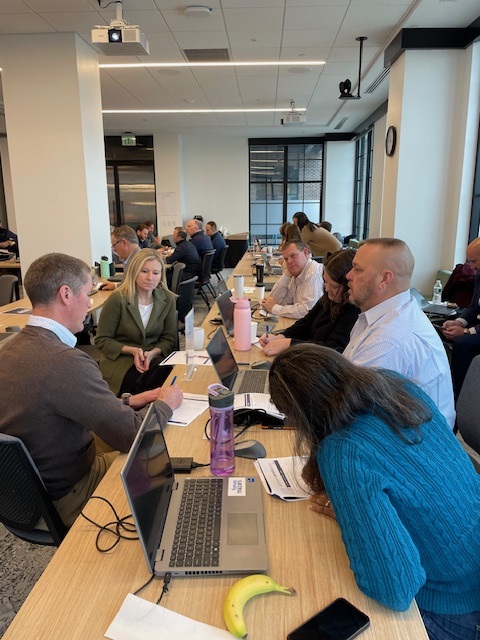
Clustr's programs are in-person first and hybrid by design. For a global professional services firm we ran regional, instructor-led workshops that started each session with local discovery. For a publicly listed energy shipping company we aligned AI strategy to an Oracle Fusion ERP rollout and broadened Microsoft Copilot adoption. Manufacturing programs use the same approach on plant and supply chain work.
Trusted by teams at


















Generative AI for Manufacturing, answered directly
Updated October 2026
What are the best generative AI use cases in manufacturing?
The quickest wins are document-heavy tasks around production: drafting and revising SOPs and work instructions, summarizing quality and nonconformance records, searching maintenance history and manuals, comparing supplier quotes and contracts, and explaining ERP and production reports. A person reviews every output before it is used.
Is generative AI safe to use on the plant floor?
Used for drafting, searching and summarizing, with a person responsible for the decision, it can be. Programs set clear rules first: which approved tool to use, what data may go into it, what AI may draft, and where review is mandatory. AI is not connected to control systems.
Which AI tools do you train manufacturing teams on?
Whichever your company has approved: Microsoft Copilot, ChatGPT, Claude or Gemini. Many manufacturers already license Microsoft 365 Copilot, so programs often start there.
How do you measure whether AI training worked for a manufacturer?
With SINA, Clustr's AI literacy platform. Everyone is assessed before training and again at the end on the same five dimensions, and the workflows built during the program are tracked for adoption and time saved.
Do you work with multi-site manufacturers?
Yes. Programs can run site by site in person, with a hybrid option for shifts and remote teams, and Champions named at each site so practice continues after the program ends.
We use cookies
We use cookies and Google Analytics to understand how visitors use our site. Privacy Policy